
Rethinking Retirement Income Planning
Written By: Nick Ziarek, CFP®, CFA
A question that often comes up in our meetings as clients start to entertain the idea of retirement is, “What is my number? How much do I need saved to comfortably live?” For many, the answer is complex and multifaceted, including variables that you both do and don’t have control over. Two of those main variables are Safe Withdrawal Rates and Sequence of Returns Risk, the first of which you have control over and the second you don’t.
Safe Withdrawal Rates
Ever since the initial research on safe withdrawal rates by William Bengen in 1994, 4% has been considered the rule of thumb. Bengen found that retirees who started with a 4% initial withdrawal rate and then adjusted it for inflation every year, regardless of portfolio performance, would not outlive their savings. He did this by examining every rolling 30-year period from 1926 to 1974 for a balanced 50/50 portfolio of stocks and intermediate US Treasury bonds.
From the research, the worst year to retire historically was 1966, where the safe withdrawal rate came in at 4.2%. Periods starting in 1929, 1937 and 2000 also experienced near failures.
Bengen would later state that the 4% guideline was intended as a worst-case scenario as the data showed periods where the rate could have been as high as 13%. Historically, he said the average safe withdrawal rate was closer to 7%.
The 4% rule remains a reasonable starting point, although research has evolved over the years suggesting initial rates can be higher. The key is the retiree has the ability to be flexible and reduce withdrawals (from the inflation-adjusted amount) in years when markets are down, especially in the early years of retirement when sequence risk is highest.
Sequence of Returns Risk
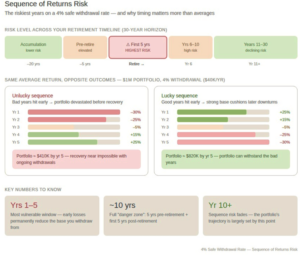
The riskiest period for sequence of returns risk is the 10-year window centered on retirement — roughly five years before and five years after the day you stop working. But the single most dangerous years are the first three to five years of actual retirement.
Why the First Five Years are Most Dangerous
For example, if you retire with $1M and withdraw $40K/year (4%), you’re taking withdrawals to fund your life. Those withdrawals can come from dividends and interest, or from selling shares. If markets crash in year one or two, dividends and interest rates may be reduced, forcing you to sell more shares at the worst time and locking in losses at a permanently reduced share count. Even if markets recover strongly later, you have fewer shares left to participate in that recovery.
The math is unforgiving early on. A 30% crash in year one vs year twenty has radically different outcomes. By year twenty, your withdrawals are a smaller fraction of a larger (hopefully) portfolio, and you have fewer years left, so a crash has less time to compound against you.
The pre-retirement years (roughly five years out) also matter because they are when your portfolio is at its absolute peak – the most dollars you’ll ever have at risk. A market pullback at age 60 with a too-aggressive portfolio can set you back years in terms of portfolio sufficiency.
Why Risk Fades After Year Ten
If your portfolio has survived a decade of 4% withdrawals with a reasonable return sequence, the math generally shows it’s likely to last the full 30 years. This is due to longevity being shorter, allowing less time for market volatility to impact the overall projection. Bengen’s original research and subsequent studies found that the worst historical outcomes were almost always determined in the first ten years.
Common Mitigations
– Holding 1–3 years of expenses in cash/short bonds as a “buffer” so you don’t sell equities at lows.
– Flexible withdrawals – cutting spending 10–15% in down years has an outsized protective effect, especially in those early years.
– The “glide path” approach is starting retirement slightly more conservatively to protect from volatility and shifting to more equities in later years (counterintuitively).
– Delaying Social Security to provide a larger guaranteed income floor, reducing reliance on the portfolio in later years.
Managing the early years of retirement matters. Reach out to your Shakespeare advisor to create your long-term plan for retirement. We are here to help provide peace of mind.