
Financial To-Do’s for Students Heading to College
Written By: Isaac Charpentier

The start of summer has been an exciting time for the bird-watching enthusiasts in the Shakespeare office. The birds have been busy building nests, rearing young, and fending off predators with the hope that one day their chicks will make the leap out of the nest. Around this same time of year, many parents find themselves in a similar situation preparing for their children to make the milestone transition from home to college. While parents don’t need to fear for their children’s survival like our aviary counterparts do, the underlying concern remains: Are my child’s finances set up for a strong launch into college?

Mindset
No builder starts construction on a project without first sketching out a blueprint. Just as a blueprint is essential to construction, a positive mindset is equally important for a student transitioning to college. This mindset can be broken into three categories:
– Patience
– Consistency
– Self-Control
For college students, patience looks like the balancing act of envisioning a prosperous tomorrow while being content with the tiny steps needed to get there today. The tiny steps along the journey build into a strong financial future through consistent savings. The ability to save consistently is maintained through strong self-control and the power to say “no” to spending today, so it can be a “yes” in tomorrow.
Budgeting
For many, the establishment of a positive mindset is the hardest part of transitioning into adulthood. With that complete, the disciplined practice of good financial habits is more easily achieved with a good framework to follow. Sticking to a budget provides consistency. Allocating 50% of income to needs, 30% to wants, and 20% to savings keeps money from mysteriously vanishing each month. As a rule of thumb, 3-6 months of savings should be set aside as an emergency fund in an account yielding a competitive interest rate. Many online banks offer high yield savings accounts, otherwise money market mutual funds held in a brokerage account can be a second option.
Debt
Unfortunately, college is often synonymous with debt. Student loan debt can be a ball and chain to financial health. JP Morgan noted in its 2026 study on college planning that “nearly all recent graduates (97%) with college debt have delayed or abandoned life goals, such as buying a home or starting a family.” The average cost of tuition is increasing at a rate of “5.5% per year” making creative planning essential for students looking to minimize this financial speed bump, such as:
– Attending in-state colleges
– Completing general education credits at a community college
– Commuting to a local university
– Applying for aid and maintaining high GPA for academic scholarships
– Working part-time during school
– Selecting a major that results in an in-demand career
In addition to college debt, students must remember to pay off any outstanding credit card balance by the end of each month. Charging a balance to a credit card with a small limit and paying it off each month creates the start of a credit score which will serve them well post-graduation. Be careful not to be drawn in by credit card rewards. Remember that the rewards are a result of spending, not a reason to spend.
Source: J.P. Morgan Asset Management. (2026). College Planning Essentials

Investing
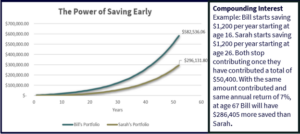
Saving for retirement can feel like a distant concern since careers haven’t even begun. However, opening a Roth IRA and contributing monthly can make a meaningful difference. Waiting for the “right time” to invest is as reliable as counting on the weather forecast. The difference between starting early and starting late is illustrated in the graph below:
Additional tips for students just beginning to invest are:
– Invest in target-date retirement funds for simplicity. They capture the whole market, and you can “set it and forget it”.
– Be careful with trading individual stocks or crypto. These options are far riskier than index funds or ETFs. Fine to be traded as a hobby but not to bank your future retirement on.
– Open a Roth IRA instead of a traditional IRA, this will allow for decades of tax-free growth and tax-free withdrawals at retirement.
– Post-graduation, after landing your first full-time role, make sure to take advantage of your employer’s 401(k) match, if offered.
Estate
If planning for retirement is far from most students’ minds, then planning for what would happen to them should something tragic occur is likely even farther. A good starting place is to establish powers of attorney; these would serve if the student were incapacitated:
– Durable Power of Attorney – This document authorizes a trusted person to make financial, legal, or other specified decisions on the student’s behalf. Be sure the document is durable as non-durable powers of attorney do not survive incapacitation.
– Healthcare Power of Attorney – This document authorizes a trusted person to make medical and healthcare decisions on the student’s behalf.
Affordable programs like Rocket Lawyer or LawDepot can be used to create these documents quickly and inexpensively. After graduation, as life and assets become more complex, it may be worthwhile to redraft the documents with an estate planning attorney. For students just starting out, online programs are a good first step.
After these documents are in place, students may choose to skydive, bungee jump, or pursue a career as a stunt double. While estate planning can’t prevent bad decisions, it can make sure the student’s loved ones are empowered to step in if an adventure goes sideways.
Final Thoughts
Making the transition from home to college does not need to feel as perilous as a bird’s first leap from the nest. Students can chart a wise path forward by harnessing the power of a positive mindset, practicing good financial habits, minimizing debt, capitalizing on the power of compound interest, and putting estate documents in place. These steps can help students to spread their wings with greater confidence and independence.